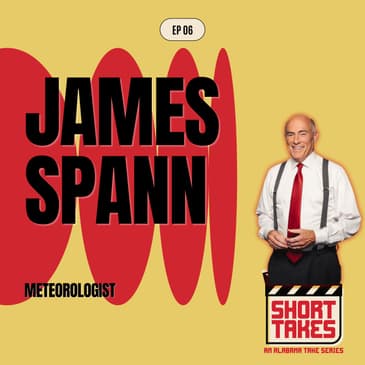
In the season finale of Short Takes, host Blaine sits down with a very well known face for Alabama residents: James Spann, Emmy winning chief meteorologist for ABC 33/40.
Here James talk about his daily activities off the air, the Alabama Weather Network App, what he considers art, how to handle criticism, and what's done up real good for him lately.
For more from James Spann, download the Alabama Weather Network App here on Apple: https://apps.apple.com/us/app/alabama-weather-network/id6748039126
Or here for Android: https://play.google.com/store/apps/details?id=com.awn.wx&hl=en_US
For more from The Alabama Take, visit the home site here: https://www.thealabamatake.com
[00:00:02] Welcome to the season finale of Short Takes. This week, it's one of the few guests I really wanted for a while and finally got. It's the famed weatherman, meteorologist James Spann. In fact, he could be my most well-known guest to date. If you enjoy Short Takes, let us know. We'll try to get more produced next summer. But for now, let's get into the conversation with James Spann.
[00:00:29] Short Takes. Hello. Welcome and with me in this episode of Short Takes is a man whom I'm very happy to have as a guest for sure because I grew up seeing him, trusting him, and that's continued into my adult years. It's Emmy Award winning meteorologist and Alabama favorite, Mr. James Spann.
[00:00:57] Well, thank you. It's an honor to be here. It's a real big honor to have James Spann on the show. James is a renowned meteorologist. Everyone knows that. But he served Alabama as the chief meteorologist on ABC 3340 for at least 28 years as chief meteorologist.
[00:01:17] Let's see. I've been at the TV station for 29. This October will be 30. I've been doing weather for 48 years. I'm old as dirt. Well, I knew you'd done weather long before you were chief meteorologist at ABC. I knew that you had done work even out in Dallas at one point.
[00:01:37] Yeah, I started in Birmingham. This is how old I am. I started in Birmingham in 1979 and worked at Channel 13. And from there, I was transferred to Dallas for a couple of years. My wife and I wanted to come back home. I'm from here. I mean, I was born here. I'll die here. I'll be buried here. But it was good to get away. I made some really good friends, but we came back and have been here ever since. So, yeah, I'm living a dream.
[00:02:04] That's great. It's home. Do you have a favorite memory or two of these 50 plus years of work? Well, there's some highlights and lowlights. I guess probably most one of the more interesting events I worked was in 1993. This was in March of 93. It was about 75 degrees, a sunny day, and we got on TV and forecast a blizzard.
[00:02:30] And hardly anybody believed this. And quite frankly, I don't blame them. I wouldn't believe me either. Because, as you know, our skill set is somewhat limited with winter storms. But this one actually verified nicely the blizzard of 93 was generational. In the middle of March, the flowers were blooming. It had been 75 degrees, but we had officially in Birmingham 13 inches of snow. Parts of the state had two feet, and the snow drifts were five feet in some spots.
[00:02:59] We had convective snow with thunder, lightning. Some people were disoriented. We had a total whiteout during the height of the thing with hurricane force wind gusts up on the mountains. So that was probably the most unique event that I worked. And, of course, we've had some horrible, horrible, horrific tornado outbreaks. April 27, 2011, and one day we had 62 tornadoes and 252 people died on my watch, which is inexcusable. That cannot happen again.
[00:03:28] If it helps any, you saved me that day. Well, and I do know that there should be a time where we celebrate the lives saved because of the warning process. And I'm just a small cog in this warning process. But clearly something didn't work because the warnings were excellent that day. It was 62 tornadoes. There were good warnings for all of them. All of them. And in some cases, the lead time was 40 minutes.
[00:03:57] And what we learned that day is that what we do is not enough. All I know is physical science. My first major in college was electrical engineering. I was an engineer for three years. And because nobody ever told me that you could do weather for a living. Nobody. And I figured it out. And that was about the time Mississippi State started their program. And so I finished in meteorology at Mississippi State. So my background is numbers, engineering, and science. That's all I know. I know nothing about human behavior.
[00:04:26] And we're asking people to radically change their behavior to save their life. And so what we've done, we've gone to social scientists, these brilliant men and women that understand behavioral science. And they've helped us. And I think we're much better now than we were in 2011. Because, again, that can't happen again. And the next time we have a day like that, I'll be at Elmwood. But those days happen about once every 40 years. We had a day like that in 1974. Had a day like that in 1932.
[00:04:56] Had a day like that in 1884. But all it takes is one. I mean, you know, all it takes is one tornado. And if that sucker comes down your street, that's your April 27th. So I think we're better now than we were thanks to the integration of social science into physical science, this interdisciplinary approach. That's fascinating that you had to lean into social science as much. But it makes sense.
[00:05:24] You know, you grew up, I think, in Tuscaloosa eventually. You eventually landed in Tuscaloosa. Yeah, I'm from Greenville, this little bitty town in South Alabama, which is great. But we had to move to Tuscaloosa when I was an older child due to family circumstances. But my people are from Greenville, Alabama, Butler County, places like Chapman, Georgiana, McKenzie, Industry, Ebenezer, places you've never heard of before. But those are my people. If you ever drive to Mobile or Gulf Shores, you'll drive through.
[00:05:54] You want to know about my people? Just stop in Greenville. Those are my people. But we had some negative family circumstances that forced to move to Tuscaloosa when I was older. And Tuscaloosa became a special place. It's not – I don't sit at home. When I got there, I just worked. I didn't know that many people in school. I worked before school, after school. But there were some wonderful people that loved me and my mom and encouraged us and helped us. And we made it. It wasn't easy, but we made it.
[00:06:24] So Tuscaloosa is a special place too. Did you have a moment at that time where you thought, I would love to predict and discuss weather? Oh, goodness. My first grade teacher taught me my passion in life. Edna Earl Porterfield. That woman was mean as a snake. She called us by her last names. I never knew my friend's first name until second grade. And the first day of class, I remember the first thing she said. She said, hey, hey, I'm not your friend. I'm your teacher.
[00:06:53] Now you walk into first grade classes. They all go, hello, friends. Times have changed. But she was the meanest teacher on the planet, but she was the best. She noticed that I stared out the window all the time. And that's rude. It's disrespectful. You know, she's up there pouring out her heart and her soul. And I'm just staring off out in the window. I don't even know what she was talking about. And she yanked me out in the hall one day, and I thought my life was about to end at the age of six.
[00:07:20] But instead of getting in trouble, she gave me a book from the library about weather. She thought I was interested. And what she did for me, she taught me my passion in life in first grade. Most people, it takes years beyond that to figure it out. Some never figure it out. But I figured it out when I was six years old. And so I am so thankful for Edna Earl Porterfield. You have to follow your life, your passion in life to be successful. You have to. You have to.
[00:07:48] And knowing it at a young age was just, it was very special. My wish for everybody, you and everybody else, is that they wake up and they cannot wait to do what they do in a day. They can't wait to wake up and do what they do. And I've had that for 48 years. You talk about being blessed. That's outstanding. I literally am living a dream.
[00:08:13] One of the major contributions you've added to Alabama and the community is pretty recent. It's your implementation of the Alabama Weather Network app. Yeah, I've always wanted to take care of the whole state. I know this state better than anybody. You do. I'm not good at much. I work hard. That's my strength is work ethic. I'm not that good at much. But I know this state better than anybody.
[00:08:41] And there's a lot of – and again, I'm from rural South Alabama, all right, about halfway between Montgomery and Mobile. And so much of this state is underserved during critical weather events. And nothing on the old school TV broadcasters. But something had to be done. And so – and the way people get information, it's radically different now. When you want to know what the weather is going to do, you pop up your phone and you're looking at an app. When the weather is dangerous, you go to somebody streaming on YouTube.
[00:09:11] And so we moved our products and services from the old school Ron Burgundy days into the new world. And it's been a marvelous transition. And I still do weather for 3340 on a couple of newscasts today. I've been there almost 30 years. I don't want to do anything to hurt them. But we're kind of phasing that out. And the new network takes care of the whole state. You name it, we got you. I don't care what TV market you're in. I don't care who issues the warnings for you.
[00:09:41] We've got your back. Whether you live in Pansy, Waterloo, Lower Peachtree, Leroy, Bridgeport, Cleabert Springs. It doesn't matter. I've been to your Dollar General. I know where you live. I've been to your school. I've talked to the kids in your schools. And that knowledge of the people, culture, geography, and microclimates puts us in a very unique position to serve people here. So it's exciting. It's been an incredible journey. We put that thing on in August of last year.
[00:10:10] And we've not had any really big major events, thank goodness. But we all know that's going to happen. And I've never had this many people or resources in my career. It's incredible. It's great. I've used it a few times, sometimes just to see if it's raining nearby and to see if that's going to begin or end. You're talking about your memory of small towns or knowing some of these places. You're one of the few people I bet I could tell you where I'm from and you know where it is.
[00:10:39] I'm initially from Sulligent, Alabama. Oh, Lamar County, come on, man. Sulligent Blue Devils. I mean, come on. I've got my Blue Devil shirt. Did you graduate from Sulligent? Yes, I did. Went there my whole life. Once a Blue Devil, always a Blue Devil. Never forget that. I agree. And now I currently live in Arab, Alabama. What are you doing in Marshall? I was in Marshall County today. No way. I was in Marshall County today. Wow.
[00:11:07] In Albertville, home of the Aggies. Yes, sir. So was I. I was briefly over there today. Well, you should have come by. You know, there's a big, big rehab nursing home facility in Albertville. And I did a program there and it was just great. We had a great time. And in the summer, normally during the, I'm in a school. But obviously we're in summer. So it frees me to do some senior adult type things like that. Man, they had a, the cake was incredible, but they had donuts. Let me tell you what.
[00:11:38] They had bacon covered donuts. I've never had that in my life. I mean, bacon is the candy of meats. That was outstanding. I mean, that was a joyous moment when they were serving those bacon covered donuts. I've never heard that. I never had that in my life. So big shout out to Marshall County. That was good stuff today. Yes. Yeah. Marriage is what led me here. And here we are.
[00:12:05] Do you get your memory from visiting as much as you do? Do you know these towns from just having done the weather for so long or both? No, you have to, you have to hit the road. You have to be a road warrior to do this successfully. You cannot stay in a weather office all day. You have to get out. And for me, it's doing the school programs. In the morning, I work a shift at home between 4 and 7 a.m.
[00:12:32] I produce products for radio and old school TV and all this stuff. It's a very intense shift. And then I go speak in a school every day. My first open date for a school program is now in 2028. Some days it might be in Dothan. Some days it might be in Scottsboro. Some days it might be in Camden. And every day it's different. And when you're on the road every day, it gets in your mind. You've been there.
[00:13:01] And you need to keep doing it. You just can't do it and stop. You've got to keep going. And so I can close my eyes and I can see the roads where people live. And again, I like to stop in Dollar Generals. That's where real people hang out. If you want to talk with people in this state, go into a Dollar General. And most people don't know where they live based on a map anymore. And it's not their fault. It's technology. Today we've got these phones. And you've got turn-by-turn directions. You don't need map skills.
[00:13:27] So if I get on and say there's a tornado 14 miles southwest of Clanton, nobody knows where that is. But if I say that thing's near Jim's Pit Barbecue, everybody in Billingsley, Alabama, knows where that is. And so by using well-known landmarks. And in this state, it's Walmarts, Dollar Generals, barbecue joints, gas stations, big landowners that's got a big farm.
[00:13:54] Anything like that that can help them to make a decision to keep their family safe, that's important. So for me, being out there on the road is just critical. A lot of people don't do it, which I don't understand. And it's just a long day, but it's a good day. I don't sleep much, but I'll sleep when I'm dead. You answered my next question, which is what sort of things are you doing when you're not on air? And that sounds like what you're doing. Well, and the thing is, you've got to take care of yourself physically.
[00:14:24] And I didn't do that for a long time. I literally thought I was physically dying about 15 years ago because you're sleeping three hours a night. Your diet's horrible. That's not going to work out well. So I actually started going to a gym in my late 50s. And the first sessions were brutal. I mean, man, I was sucking wind after – I mean, I couldn't do anything.
[00:14:51] And I literally went back to the place where I worked, the TV station back then, and vomited after the third time. My body just rejected it. But it started to kick in. And so I've been doing that for over 10 years, and that's changed everything. I'm strong as an ox. I'm old as dirt, but I'm strong as an ox. I back-squatted 240 pounds in air the other day. My legs work good. And when you're in good physical shape, your mental cognition is better. I've never been this sharp mentally.
[00:15:18] Most people at my age, they decline where my cognition skill is going up. And that's critical when you're doing live weather coverage. You make a mistake. You've got a problem. You could kill somebody if you call out a wrong street, if you make a big mistake like that. So the physical part of it is critical. So I am dedicated to going to a gym three days a week. And you've got to be dedicated to do that. It's easy to blow it off that, well, I'm going to go do another school. Nope.
[00:15:49] And that's changed everything. So people need to pay attention to their physical health. That's critical. And that's really helped me. That's great. Before we get into our four questions, which is kind of the heart of our show, just a quick reminder, that's the Alabama Weather Network app. Easy to find. I found it with one quick search. Let's get into our four questions. And I'll ask you your first. What's a piece of art that's had a big impact on you? Oh, man.
[00:16:18] I'm a South Alabama hillbilly. I'll tell you. I'll give you a straight shooter here. Art, it's the sky. Nobody looks up. Nobody. Nobody looks up anymore because this is what we do now. We stare at these things. You're missing the greatest artwork ever made. In fact, we came on here. I was showing you some scud, you know, some clouds. And when I was a little boy, this is what changed my life.
[00:16:42] When I was a little boy in rural Butler County on summer, hot summer days, I would just sit out in the middle of nowhere near Chapman, Alabama, just laying flat on my back, looking straight up. You talk about art. The towering cumulus clouds we see on summer days in the Deep South. You can see things in them. You can see animals. You can see people. You can see it change from minute to minute, literally second to second.
[00:17:09] And you're basically learning the convective process without knowing you're learning that. So that's my art is looking up. Nobody does that anymore. I triple dog dare everybody watching this show here. Put your phone down. Go outside. Spend about 15 minutes and look up sometime. You'll see things that will blow you away. Since we've been talking about 20 minutes, I've had over 400 images sent to me, 400 of the sky.
[00:17:36] And it's unbelievable what you have been seeing out here this evening, just on this one summer evening. Everything between rainbows, between shadows cast by 50,000 foot thunderstorms with this amazing sky texture, these sunset views with the cirrus convective debris. It's stunning. So it's probably not a good answer, but that's my answer. My artwork is the sky. I know there for a while on social media, sometimes you would enjoy the music that you were hearing when you're out and about,
[00:18:05] like in a grocery store somewhere. I was curious if you'd have a song in mind. Yeah. So, hey, I was in the Piggly Wiggly the other day. I hang out in the Piggly Wiggly when I'm around here. And you won't believe what they were playing. You won't believe what they were playing. Freebird. And you probably never heard this song. You probably have never heard the song Freebird. Yeah. I don't believe you. I love Freebird. Because you're too young. Oh, I'm not that young.
[00:18:35] I'm lucky in that I don't look that old. When I was a child, I worked at a radio station. I had to. We were low income. It was me and my mom. We had no money, no hope, no friends. When we moved to Tuscaloosa, it was bad. My father had abandoned both of us. And I worked. And I worked at that radio station making $1.65 an hour through high school and college. But, man. Wow. What a decade to be playing these songs in the 1970s.
[00:19:04] And, you know, one minute you'd be playing Freebird by Leonard Skinner. The next minute you'd be playing Goodbye to Love by The Carpenters. The next minute you'd be playing Stairway to Heaven by Led Zeppelin. The next minute you'd be playing Night Fever by The Bee Gees. It was the most bizarre, eclectic mix of music ever. So, yeah. I go into a store. I'm always listening to what they're playing on a speaker. But when they played Freebird and the Piggly Wiggly down here, that was a happy day. That was good. Oh, wow. That's funny that they were playing it.
[00:19:33] It's so long, too. All right. Your second question. What do you think makes for a good friendship? I'd say consistency. People are just, a lot of people are wishy-washy. You know, I'll be your friend one day. The next day, I'm not your friend. I do children's ministry. So I see this in kids, which is to be expected with children. That's just what kids do. They're wishy-washy. They're growing up. They're learning. And, you know, someday I'm your best friend. Some days I'm not.
[00:20:01] Well, I see some people that are 30, 40, and 50 years old doing that. But inconsistency means that you're a friend during good times and you're a friend during bad times. Every human being goes through some hard, hard seasons. Everybody. We all do. I do. And if you say you don't, I've got a good sermon on lying. And when your friend is going through a really hard time, the best thing to do, the easiest thing to do is to abandon them.
[00:20:29] I don't want to get involved in that, but sticking with them with consistent care, compassion, empathy, to me, that's the big deal. Consistency. That's thoughtful. Good stuff. I know that sometimes you get odd, dare I say, some negative responses as part of the job. I follow you online. I see some of these.
[00:20:54] For the negative responses, what's the best advice you could give someone for not taking things like that personal? Well, in my case, I'm so old. I tell people all the time, you cannot hurt my feelings because I have no feelings left to hurt. But for the younger people, it's a challenge. And let me just say it's really hard for young women, hard in my business. The harassment they deal with. What I deal with is nothing compared to what they deal with. I've seen it.
[00:21:23] I've worked with a lot of young women over the years, and I've seen what they deal with. And it's just absolutely horrific. The key thing for everybody, and again, this is for children too. I spoke with some rising sixth graders today. After Albertville, I was at very middle school. Rising sixth graders. I told them, don't you dare. Don't you dare get your self-worth from what somebody says about you on a phone. Don't do it. And that's critical. You are special. Every human being is special. You were born to do something.
[00:21:53] And I will never be able to do what you do. Never. I can't. Because you were born to do it. You're unique and you're special. And that's your self-worth. It's not what somebody else says. It's just understanding that you're special. You have unique skills and gifts. And you were put here for a specific reason. And you've got to stay focused on that. And the other thing too is to have a sense of humor. We live in a world now where nobody laughs anymore. I don't know what happened.
[00:22:22] I mean, people used to have a good sense of humor. Now nobody has a sense of humor. Sometimes you've just got to laugh at this stuff. What I'll do, and I get these all, I get them every day. I hate messages. But I'll pick a choice one every week or two and blurt out the name. I don't want to dox anybody. But I'll say, good morning to everybody except this guy. And sometimes you have to laugh. That's all you can do is just laugh. That is pretty funny when you do that.
[00:22:51] It always makes me chuckle. We like to ask every guest our last question. It's just what's done up real good for you? Our way of saying, what's making you happy of late? What's making me happy is the fact that I get to wake up and do what I love to do. How many people can really say that? I don't know. My wish is that a majority of the people can say that. But I see so many that just don't like what they do.
[00:23:20] And what's working for me is the fact that I get to wake up and I get to look at weather maps. And I get to try and solve the puzzle of what the atmosphere is doing. It's the ultimate puzzle. It beats anything you'll see in a newspaper or print or online. And then, in addition to the routine stuff, you get to help people make decisions that can save their life. When you've got tornadoes flying around here and you've got a flash flood, you've got a hurricane.
[00:23:50] How many people can say that in their job? And again, we're just a part of a process, but we give people the information they need to make the decisions that can save their life. And I think that's just stunning. And I look back on my background. I had some struggles. A lot of people don't know this. I'm very dyslexic. I have a hard time reading. I'm a math guy. When I was in high school, I was called retarded. And that was the word they used back then.
[00:24:19] You can't use it today, but it's no big deal. But they didn't know what to do with me. But the math teacher said, wait a minute. This guy's brilliant here. He's doing like differential equations here in 10th grade. And, you know, what I tried to do was just take the strengths, not focus on my weakness. If I had to be like those news anchors and read a teleprompter, I would melt down. I mean, that ain't happening. Whenever you see me, I'm not reading. I'm talking.
[00:24:45] And I've just taken my strengths and my passion in life, which is weather, and a work ethic. And it's just been a great ride. Goodness gracious. And the other thing, too, at my age, I'm old as dirt. I've got underwear older than you. But I'm able to do things I couldn't do when I was 30 physically. And I feel better now than I felt when I was 30. My mental cognition is better. And I see so many people my age, and they just look elderly.
[00:25:15] And their health is bad. And it's not good. And so I've got this opportunity to where I can keep going. I'm just getting started. Why would anybody retire? When you've got a dream job, you're in good health. It's a ministry-type job where you're serving people. So just the fact that I can wake up and do this every day, that's my jam. This is what I do. Man. Well said. I, many others, are very happy you're doing it.
[00:25:43] Very happy to hear you're just getting started because you're great at it. And we need you. So. Well, predicting the future is hard. Yes, sir. You know, trust me. You learn humility real quick in this business, especially when it comes to snowstorms. But, no, it's. And the other thing, too, I want to help the next generation. I love the next generation. I just think their work ethic is great. I think they have a servant's heart.
[00:26:11] I just love that the young people I've worked with over the past several years. We just hired a young woman from a new graduate from Mississippi State. And, boy, she's great. And I want to give them hope in a future. I don't want to leave them a dumpster fire. You know, the Ron Burgundy 1980s newscast. Good evening. I want to give them a vibrant model that will carry generations into the future. And that's what we've done with this new network. And that's energized me as well. So I'm pumped. I just love living every day.
[00:26:41] I want to shout it out one more time for listeners and viewers. That is easily downloaded. Put it on your phone. And you'll feel a little better about the weather that day. It's the Alabama Weather Network app. Just go find it. Search it. Easy to find. And I'll tell you how beloved you are. I have a college friend who landed in Connecticut. That's where he lives and works with his wife. And he has a friend in that area, or I think he may have been a student,
[00:27:10] who found out that my friend knew you from just the weather. And he was blown away. He loved it. And he said, James Spann's helped millions of people. And this guy was very much into weather and those types of things. But he knew you, that you were the top of his list. Wow. I'm honored. That's outstanding. It's fun. It's fun to hear those kinds of things. And you hear it, I'm sure.
[00:27:38] But it's always good to hear it one more time, that you're doing a great job. And we appreciate it. I'm here to serve. It's an honor. Thank you for joining us, and we'll see everyone later.