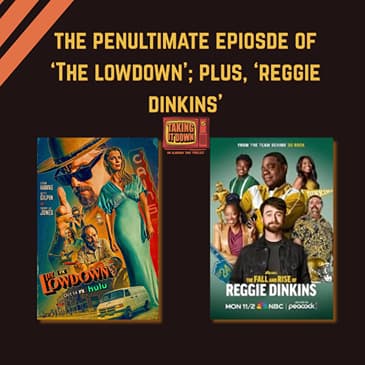





After a quick hello and overview (0:03), hosts Blaine and Donovan the oddity of broadcast TV (0:39) which leads into a preview of the upcoming series 'Dig' on Peacock (3:55). From there, they briefly discuss the second season thus far of 'The Fall and Rise of Reggie Dinkins' (6:36) before getting into the penultimate episode of 'The Lowdown' (11:33).
After a short break, the two then discuss the specifics of what made 'The Lowdown' and its seventh episode both really good and only pretty good (17:15).
For more, visit The Alabama Take site.
[00:00:01] Hey everyone, thanks for tuning in. On today's podcast episode, we have a brief conversation on the NBC and Peacock series, The Fall and Rise of Reggie Dinkins, before getting into the FX, Hulu show, The Lowdown, and its 7th and penultimate episode. As with every Sunday afternoon on this podcast, we discuss things with non-spoilers to begin before taking a break, and then getting into spoilers of the episodes. So let's get the episode started. I'll take projection.
[00:00:37] Okay, we're not back. We're here. I almost said we're back. I guess we are back. Back from last week. Yeah, we're back in a spiritual sense. Sure. Joining me now is Donovan. That's him you hear. Welcome to Donovan. We're starting the show officially now. You heard the intro twice. The intro music. So it's time to talk TV. Right? No. That's not why I came here. You tricked me.
[00:01:05] You and I were both big fans of the first season of The Fall and Rise of Reggie Dinkins, which is an NBC and Peacock. And let me just say I have to force myself to say NBC. It's like broadcast doesn't exist anymore for me. I have to think broadcast, NBC, okay, that's related to Peacock. That's how I view it. It's an NBC show.
[00:01:58] It's like I read on ESPN's app or whatever. It's so weird. Yeah, me watching clips of John Mulaney from Saturday Night Live does not count as me watching broadcast TV. Oh, I do watch that almost every Sunday morning. Almost. It is just for whatever reason. It's funny that by and large, just for whatever reason, NBC seems to be the show that I'll be watching. Like I watched The Good Place when it was on. That was NBC. Watched Parks and Rec. That was NBC.
[00:02:28] But I'll tell you. I'll give you my two cents right at the beginning. The last show that aired on broadcast TV, it made me watch it like an old person live. The last show on broadcast TV that was truly essential was NBC's Hannibal, which was incredible. Oh, really?
[00:03:16] Blink and you'll miss it. But was it not The Good Place? Did you not watch it live or did you watch it on streaming? I didn't watch it live. I usually watch it the day after. I think that's what I did too. But by the time the third season of Hannibal rolled around, I was like at my house, like I'm turning on my cable TV and I'm watching this live with commercials. That's what it did to me. Do you even have cable TV anymore? I have YouTube TV. So no, but sort of. Yeah, sort of.
[00:03:45] It's kind of like what's the difference at this point. Yeah, live TV. I could watch things live if I want to. But that does bring, before we get into Richie Dinkins, it brings up a good note. Have you seen the ads for the new Michael Schur show? Speaking of The Good Place, Michael Schur, creator, writer. It's called Dig. I have. Yeah. Got Amy Poehler in it. I need to look more into it, but that's already a good pedigree.
[00:04:14] Amy Poehler, Hugh Laurie. Also a good pedigree. This is completely unrelated. I'm just going to word associate today. It's what we're doing. There's a park with a little splash pad in West Hartford, which is about 20 minutes away from me. It's where my brother and sister-in-law and their kid live. And if you go, they have like a little splash pad. It's real cute. Great for kids.
[00:04:39] Playground, pool, but the park, the pool pavilion is the Leslie Note pavilion. Because Michael Schur gave a little, he used to live in West Hartford. He gave a little money for it, so you can go to the Leslie Note pavilion. Oh, wow. That is kind of cool. How far away is that from you? 20 minutes. Oh, wow. Give or take. Depending on Hartford traffic. I think I have been a fan of most everything he's done. Schur has done.
[00:05:09] Big fan of Amy Poehler. Hugh Laurie is really funny when he wants to be, but I also think that's kind of a great pairing. Because it's not expected. Mm-hmm. Now, it could be terrible. I hope it's not. The headlines I've seen is that it's not as funny as you think it's going to be. That's too bad. But that it's still kind of good, I guess. I don't know. It's like not as straight comedy, apparently, is what the headline alluded to. I don't know.
[00:05:37] You know, thinking back to The Good Place, I do think that that took a while for me to build, especially in the first season. So maybe this is a case where he knows what he's doing, or maybe we're just not asking for the right thing from this show. I really like The Good Place. Oh, that's very good. Yeah, I thought it was great. And I like Michael Schur. I think I'm a little oversaturated with Amy Poehler. From what?
[00:06:02] I just see her podcast clips on every social media. It feels like the algorithm feeds that to me, and I think I'm a little over her. Interesting. At the moment. I don't think I've seen any of those, so I feel undersaturated with Amy Poehler because I can't remember the last thing I saw her in. It would be reversed if this turns out to be a good show. I wouldn't feel as oversaturated. I'd just feel more welcoming to her. Right.
[00:06:32] But anyway, that all goes back to Peacock, NBC, and Reggie Dinkins, which is on NBC. It stars Tracy Morgan, Daniel Radcliffe, Precious Way, and Bobby Moynihan, where Tracy Morgan's Reggie is making a documentary about his return to glory as a disgraced NFL star. Not necessarily getting back into playing, but just making his face known as a positive with the help of Daniel Radcliffe's Arthur Tobin.
[00:07:02] The best British name in a long time. We won't be saying anything about the second season in spoilers. We're going to keep it in non-spoilers. What are you thinking about the first two episodes? You've seen two. I've seen the three that are out. It's still making me giggle. I do. So long term, and I assume that people working on this are smart enough, but it's the premise of the show, right? It's like Arthur is in Reggie's life because he's making the documentary.
[00:07:30] So if the documentary gets made, it kind of destroys the premise of the show. I assume the people working on this are smart enough to figure it out. There is a little bit in the back of my head of like, how are they going to keep this going? But they have – they just have – it doesn't all hit, but it is that very speed for the jokes where a lot of them land. And a lot of them are weird or funny enough to really hit. Yeah.
[00:08:00] They haven't hit for me as much this season. Oh, that's too bad. I don't think it's as good as the first season, at least not yet, because it's not quite as funny to me. And I attribute that to the plots not being as interesting and haven't given the places where they can hang the jokes on certain things. I guess I just found some of the plot stuff not as interesting, which is secondary to this kind of show.
[00:08:27] But at the same time, it still needs to be good enough that I'm attentive. Yeah, the plots are somewhat of an excuse for this kind of thing. Yeah. I was going to say, there's been some good weird jokes that really made me laugh, just in the sense of like, it's kind of – like there's a joke that at the end of the first episode that it takes the title from, We Take the Kisses. Yes. It made me laugh so hard.
[00:08:56] I'm also having trouble remembering them. They're not sticking with me like the first season did. I can recall a few things about the first season that still are pretty funny. Yeah. Interesting. And they do return back to a couple of gags they did in the first season, which I'm happy that they're doing. Bobby Moynihan's character of Rusty has a saying that appears again and is so ridiculously stupid that it's funny. I think viewers will love it though. Yeah.
[00:09:24] The second episode somewhat centering around Rusty is Essential really made me laugh when one of his roles was listening to Reggie talk about Godzilla. And so he's got like – they have a scene where Reggie is straight up going into talking about one of the Godzilla movies he's watching. And Pino's like, what are you talking about? It's great. Hey, I've told you before. It's not Godzilla's. There's only one.
[00:09:55] Yeah, there's that plural. Hilarious. I still – I'm not degrading the show. I'm saying I don't think it's quite as funny. It's still lovable and fun and I don't not wish to watch it. It's certainly one of the things I enjoy. It's funny because it is very lovable. It's not mean-spirited, but it does kind of have like a bit of a – like kind of a – like in a different show, it would feel like much more of a bite for some of the stuff that it satirizes.
[00:10:25] Yeah. Yeah. You're right about that. Which is – yeah. Which is interesting. You know, I think – well, you know, some people, myself sometimes included, can get offended at anything. But I almost feel like if you're satirized or made a little fun of with the show, it's – they have such – they're so good-natured about it. I would have trouble imagining being angry. Yeah. That's a good point. It's – yeah, it's not going to make anyone angry. I do think people will like it.
[00:10:50] It's worth your time, and I'm here to say that the third episode for me started to turn it back in the direction that I saw in the first season. It's pretty funny. I actually found the interaction between Arthur and Reggie more – like it clicked a little faster for me in this season just because they're – I think Daniel Radcliffe has always been funny, but I just – I found him a little funnier as the character. Oh, yeah. He's good in this role. He's very good.
[00:11:20] He's – he's a funny guy. Yeah, truly. The only undamaged child star out there, I think. That's a good point. You know, a show we've discussed week to week, of course, is The Lowdown on FX and Hulu. This one's the one about a writer who's as much of an investigative journalist, though he's not hired by any official paper or magazine. That's Lee Raybon, played by Ethan Hawke. And this season he's joined by Betty Gilpin, a lawyer with a missing client.
[00:11:49] Tommy Lee Jones is a estranged father. And we'll be in discussion about episode seven, the penultimate of the series of this second season. We'll hold off on anything specific and spoilers, though, until after the break. I thought this episode was great in that it got a lot of questions answered.
[00:12:07] So that was – it's funny that that's exactly the first thing you said, because my first thought was this episode did a lot of connecting the dots without ever feeling like a scene-setting episode for the finale. You know, sometimes you just get like those info dump episodes or – and it felt absolutely integral to what is happening in the show. So I thought that it – I did feel that.
[00:12:34] I thought that it was showing some of its work kind of often. I felt like it had actually done a pretty good job of like it was building on stuff that it had already introduced. To be like, hey, here's why this episode is – the stuff we're showing you, like here's why it's still important instead of – you know, so much – now the plot is definitely more integral for a show like this. But if the plot takes over completely, you've kind of lost what made it. You know, it's a balancing act.
[00:13:04] Yeah, still a pretty good balance, but I did see it plot heavy here. We still had some good – yet another interlude that made me think of the Coens right at the beginning. So still definitely some time for some – I think it's hard to gauge this one too because episode six was no perfect. Yeah. Well, I think that's a great point, Blaine, because I think coming off of an episode like that,
[00:13:32] no matter what follows it, is just going to be different. And I mean, I think, you know, obviously like they're not going to try and repeat the sixth episode. Yeah. It has to bring things forward as well. You're right. You still have to address some things in the sixth episode while at the same time moving the plot forward. You can't linger too long on it because there are things to wrap and answer, and they do that.
[00:13:57] It was a tough tightrope to walk this week for the lowdown, and I thought they did a pretty fine job. And it's gotten to the point where the questions that have been posed throughout the seasons have to be answered. It has to get to some end point because next week's the last episode. And like I said, I thought it just showed its work here often, even though it was still good and I enjoyed what I saw.
[00:14:23] If I look at it through a really critical lens, I'm seeing the writers tying plot lines together. If I look at it through a fan lens, I enjoyed it a lot. You know, that's also the balancing act, right? Like we know we're watching something artificial, yet sometimes we don't want to be reminded that it's artificial. And sometimes that very artifice is what makes it great. Like it's hard to tell how something's going to land, right?
[00:14:49] Like there are so many, for example, like Wes Anderson movies where like the artifice is part of it. Well, yeah. Yeah, this is not that. This is not, no, this is not that by any means. It kind of nudged us as viewers toward its theme of the season just slightly enough for me to appreciate it.
[00:15:10] I thought that it, toward the end of the seventh episode, we kind of, we almost get a character saying it, but not quite. So it's more of an allusion to one of the big thematic things. Yeah, I think there was a decent amount of show with a little bit of tell. Yes. Yeah, and I really liked that.
[00:15:32] I felt that that was worthy of watching the whole episode as well as everything else that went on, the acting and the plots and stuff. I thought they did a very good job with this episode. But too, they've hit the characters at such a pitch too. That like, even if they're doing a little bit of like, okay, we're setting stuff up, we're moving things around. Like some of the characters are just such a delight to see or be reminded of.
[00:16:01] I think I'd be curious if somebody had watched this season and didn't podcast about it. Yeah. And just would tell me what they thought about this episode. Just enjoyed it. Yeah, they probably would just enjoy it. Which, don't get me wrong, I did. I actually loved it a lot. And coming off that sixth, it's just hard to not see some of the puzzle pieces, the hand that's on the puzzle pieces sliding them into place. Sure, yeah.
[00:16:31] But yeah, perfectly fine episode. And we'll get into the whys in just a little bit. In fact, let's do that. Let's take a break and we'll get into some details and spoilers on the other side.
[00:17:11] Okay, we're back. This week's episode of the Lowdown titled Hot Wieners. All-time classic title. Pretty up there. It's a business name in the episode. This has to be one of the more disgusting intros I've seen in a while for a television series. You know, I really loved this intro because it's the whole theme of this show in many ways is about how the sausage gets made.
[00:17:42] What a good point, yeah. I thought that was so clever to start that way, but it's not contrived either. Because it deals with what we already know is going on with the quote-unquote work release program. Yeah, it was brutal, a little scary for those few minutes. And I'm not just talking about the pink slime we see being made for meat, which was so gross.
[00:18:04] Because I'm talking about there was some fear in there about these guys possibly being abused and hurt. Yeah. It had that, you know, prisoner feel to it, of course. Menace. Yeah. It did. In fact, it was a jolt of a shift to see Lee in the funeral home quickly after. That was what was like right out of the columns for me. There was. Yeah. It made me laugh.
[00:18:32] I could see a little bit of what's going on, but I love his friend who's like the antique dealer. You know, it turns out he just came along because he was giving them a loan. Right. You know. Yeah, he had some pretty funny lines where he had to repeat himself to the grieving family behind him. Yes. I thought that was good comedy. But there's a bit where Lee Jr. is like, I'm going to ask you this. Is it cheaper if we just dig the hole ourself?
[00:19:01] And like just that, it made me laugh. And it felt like it was kind of a good, I appreciated it as connecting to episode six. There was some really important emotional stuff happening between Lee and his daughter while also being kind of like a funny interlude before we, you know, kind of with the plot for the rest of the episode. Like, buckle up. We're going fast now. So, it kind of helped me kind of ease into it. It also was a subtle reminder that Nathan Spence is going to end up dead. Yeah.
[00:19:31] Yeah, yeah. And there's just a note of absurdity and death and our current rituals about death and how we're still footing the goddamn bill even in death. Yeah. Yeah. Yeah. You know, it is. I mean, I think obviously Lee Sr. did not have much estate planning since it just seemed like it was a note in his pocket. Yeah.
[00:20:01] Yeah. Which was perfect for his character, of course. I do think they did a good job in this episode too of kind of very, and deliberately because we knew it. But now some of the things that we had seen as similarities in father and son are now even more explicitly said. Oh, yeah. We're the theory.
[00:20:25] Maybe some might find it clumsy, but I personally liked Lee repeating that different people, like, from his perspective as trying to talk with his daughter. Like, different people are different people to different people. Yeah. Which goes with what he said yesterday, and then of course his daughter's mother, who's done very much in her life, reminds him that he's always leaving too, which is definitely not something that he has thought of himself. You're always leaving and coming back.
[00:20:54] Exactly. Yeah, I thought that bled nicely into one another. I saw no clumsiness about that really. No, I liked it. And, you know, I almost think those moments are a microcosm of part of what makes it good, because I do think there's the bits about, like, broader thoughts about, like, personalities and who we are. There's the father and daughter relationship sometimes where maybe she feels like she's more of the parent than he is.
[00:21:23] There's the reminder that what he hates in his dad might be something that he can't see in himself. And at the same time, punctuating all of this, the dentist stepdad just, like, come on in, everybody. Bring in. Like, it was all so funny at the same time. Yeah. Done very well. But there's a truth in that. There's a truth in there.
[00:21:47] There's a, yeah, a real life thing there where the worst things about your parents are also what you probably hate about yourself or you want to work on. And, you know, I wouldn't say hate for everyone, but you definitely feel as though I've got to fix this inside of me maybe. Yeah, yeah, yeah. Or something along those lines. So you find that the show's able to slip from silly to somber. Yes. Very. How is it able to do that for you?
[00:22:17] Because I do think it does it pretty well, but at the same time, I felt as though I saw it happening this time. It felt like a jarring shift, but sometimes it doesn't. You know, I think I almost can't – I feel like I almost said so much about this last episode because I feel like there were so many good examples. Even if just like, you know, like we have the overarching thing where we're like, we know Lee's on a trip with his dad. We know he's angry with his dad.
[00:22:44] We know he and his dad have trouble communicating. And then there's Tommy Lee Jones coming out of the bathroom like, you know, you hear – you standing in there listening to me piss? Like, strong as a horse. Yeah. I think the show has established its tone so well that juxtaposition – I mean, because there is some sad, scary stuff happening in this episode. Yeah.
[00:23:07] And part of it, too, I think, is because we have the character of Lee who does care about people, who does care about the truth, who doesn't want to sell out. But at the same time, those are all the things that make him somewhat ridiculous. Oh, yeah. He's a heightened version of that kind of person. You know, yeah. So I think that that – hell.
[00:23:33] And honestly, like, that for me, too, it almost is like – this is going to sound super-duper pretentious. But I was thinking about – you know, sometimes people think about, like, what is comic relief? Like, what does it do? And I think part of it is, like, the real world is kind of ridiculous and comical. Sad, too. But I also – and this is – please feel free to edit this out because you're going to boo me off the podcast.
[00:24:01] I think about – you remember how, like, in Hamlet, before – Hamlet is – you know, he's got York's skull. He's thinking about, you know, your worm is your only emperor for diet. But – what is it? We fat all else to fat – however it goes. But you have the silly – the ridiculous gravediggers right before that. Yeah. Tell him a joke.
[00:24:36] Tell him a joke. And yet we have this funny, weird little interlude. Mm-hmm. And sometimes – now, here's the thing that I'm – I'm not sure that I can always accurately identify for you, like, what makes it work versus what makes it not work. Because there are things where, you know, you could have something so – even if it's absurd or silly, it's so tonally dissonant that you're like, that feels wrong or almost – maybe even disrespectful.
[00:25:05] Whereas here, it feels – I have kind of two thoughts about it, which is I think that they do a good job of just kind of being like, life is this mix of, like, absurd and normal. And, like, also I think – and this is sort of a broader thing, but I think that Harjo and his writers use comedy and absurdity almost in a way that it's like you – it makes you take your medicine.
[00:25:33] And by that I mean I think – I love how this show is dealing with very big themes about things that are very broken, like prison industrial complex, things like that. And it never feels – and I think they do such a smart job of using that humor and absurdity so that it never feels like you're being preached at.
[00:25:54] While at the same time, I personally think they did do a great job of letting the immensity of some of the bigger themes be very real. I think they did that very well. This episode with the young man abused in basically a slave system. And even thinking – and we'll see if they tie it in broader, if it's just going to be a kind of side thing.
[00:26:19] But thinking about the life of the artifacts and how the rich – actually, it was one of the great lines of this episode was the rich keep doing it and keep doing it. Because it could almost be the thesis of the show or Lee. Yeah. He says, oh, you got to keep exposing it over and over again. You can't just expose it once or it keeps happening. I thought that's pretty good, actually. That's really good.
[00:26:46] But that's the sad part of America, too. I mean, the world. That it is theft and – yeah, I suppose so. I can only speak as an American, I guess. Sure. That's where my knowledge kind of lies. But America is theft and slave labor. You know, you think about all the things that all through the centuries, the rich and powerful have gotten away with.
[00:27:11] And in some ways, we are lucky that there are people out there who can expose things. And sometimes things change. But it is also – again, they do such a good job of sweetening your medicine. Because it does make you think, right? Like, well, who was – who was Tulsa's land belong to? Mm-hmm. That there's – you know, that we're digging stuff up. And yeah, it's universal. But yeah, I absolutely agree with you, Blaine.
[00:27:39] It does a great job of speaking to something very American and very particular. Especially with just the interweaving of Native folks in both seasons of The Lowdown. Yeah. The big plot points from the artifacts and the prison release program are both microscopic versions of two big problems with the United States. Yep. Absolutely. That's well done.
[00:28:08] And it did get around to that toward the end where it was very clearly in focus, and I like that. Moving on, we get McMahon in the hospital. A few scenes with him. Both Sheriff Thorne comes by, brings him some chili, and she comments a little later after her visit that he was in fourth grade for three years in a row, which I found so funny. He's not the sharpest knife in the drawer. Not at all.
[00:28:35] Though he's nowhere near as dumb as Lonnie, who pulls up on a scooter and Betty Gilpin maybe gets the line of the episode where she says, I'm just surprised it's not a tricycle. Yeah. Poor Lonnie. Would you have been able to predict how important the name Chili Franks would have been? No. I thought it was just a really good joke. Me too. And it turns out it's so much more than that.
[00:29:03] I'll say that that's a brilliant piece of writing because to have a whole episode about him with that name and in any other show that's not up to par with this one, that would have been a regularly named guy. And it's going to be up to the viewer to really remember this. Commit it to memory because later on you're going to pick up on some things. Here he's still front and center. Yeah. Hot Wieners is the name of the episode.
[00:29:32] Chili Franks. There's the chili cook-off. There's the Franks reference with the Wieners. I mean, it all – plus he's such a well-acted character and to give him that much screen time and such realism with his screen time. Yeah. It's so funny we're still talking about it. He was – I mean, it feels like he was there for more in an episode when he was really there for like half an episode. But he's so – You know, just the guy like – there's something so real about it.
[00:30:02] He doesn't really say this, but the guy who's like, you want me to see – you want to watch me do my ninja moves? Like that kind of person. Yeah. And we never saw what McMahon and Lonnie did with his body after they dug him up. So that's going to be a pivotal plot point. I was going to say, I think it's – Because Sheriff Thorne asks, did you take care of him? Because she – did you really take care of him? Right. We don't know yet.
[00:30:30] And it's not long after that that he disappears. Of course, he gets a visit from the judge first, McMahon. And the judge have a scene where the judge is, again, played by Hawke. He shows up with his friendly hostility again. Man, what is he like? Two minutes? Yeah. For this whole hospital scene? It's so – and he's so good. Yeah. He comes in. Speaking of menace. Yeah. He's got it in waves.
[00:30:56] I mean, like when he – the way he plays him, when he smiles, it's almost scarier than when he's frowning. And I love that. It's so good. I do too. I do too. I do too. And he does it in the chili cook-off too with Bob. Really, really good scene. And he repeats Tang to him. Tang! Tang, tang, tang, tang, tang! Which is so much more than just the word Tang. We get Miko, finally.
[00:31:26] Miko appears at Ginger's. He's not in with Mac and Lonnie, as it turns out. He was very much against what they were up to, particularly McMahon. Man. But it also gives this horrible scene, another gross scene. And cat owners will appreciate this. But, yeah, Lee coming in through the window only to land in the litter box. So my cat, Gizmo, was sitting with me.
[00:31:54] And he's a little skittish because he's a good boy. He's very affectionate. But he's a skittish cat. He's still a kitten. And he was sitting with me. And I went, ooh! And he shot off like I'd... Look at the noise I made. I could just smell that litter. It was like I could smell it. I could feel it. Miko has, like, shaving cream or something on his face. So it's like, litter is getting... I was like, this is a... As soon as they showed the box, the used box,
[00:32:22] I was like, this is repulsively close to my real life. Yeah, the seconds before you see the litter box, I knew right then, I said, that litter box is going to be under that window. It's going to be under the window. But I'll take it. I'll take the huge over-the-top hint there because it worked out. Oh, it was funny. We get a prolonged flashback. You know, flashback and voiceovers can be a hindrance. They can be deadly.
[00:32:52] What do you think about this one? It's a longer flashback. Worked for me. I think my... Probably the worst example that I can think of a flashback where narrative is that Flanagan show, the kind of sequel to Hill House he did, where basically a whole episode is flashback. And it kills him. Bly Manor. Bly Manor. Yep. It's the penultimate episode. It's all about... And I thought it was horrible. Weird, weird, weird misstep for Flanagan.
[00:33:21] But that's neither here nor there. This, for me, worked. And the reason that it worked is because we had had so many of the kind of puzzle pieces. So we knew little bits and pieces of it. But it's like, okay, now we're seeing how it fits together. Now we're getting Miko's side of the story because so much has been... He's kind of been a big question mark in the middle of things. Worked for me. Didn't overstay its welcome.
[00:33:50] Honestly did a lot of... You're kind of trying to guess Miko's character. Shows kind of who he is pretty quickly. And just the... People don't really care what happens to prisoners. Mm-hmm. It worked for me because I thought showing it really revealed how heartless it was that Nathan died. It wasn't because of just a straight-up beating, which is not violent and horrible. But it was because they could have solved it
[00:34:19] with a phone call to the ambulance. Right. He didn't necessarily... Well, he might have died anyway, but they didn't care. Yeah. It was that heartlessness of... The simplicity of the solution, I think. If you would have told that rather than showing it... Yeah. ...it would have lagged a little punch. I think this is when I alluded to... There was a lot of show with a little tail and it worked. This is what I'm thinking of. Because you really do have to see it. Mm-hmm. Mm-hmm. And this is really the first time we've seen it
[00:34:48] instead of knowing about it. Not just the murder, but also just the conditions, the brutality of a prison farm factory. Yeah. They're horrible. And we get to see Miko's escape, which answers the howl of... Yeah. ...why he's out and about. That was nice. I thought that was fine. That made sense to me, too. Right. Because McMahon had him off to the side to make sure he wasn't going to talk.
[00:35:19] Or even maybe worse than that. We don't know. But Miko gets a chance to jump out of the moving car. Slow-moving car. We get an introduction of another guard, prison guard who's playing a bigger role here. Mm-hmm. Shorty Henderson. He not only works as a prison guard, but he is the bag man where he gets the money from the meat factory and takes it to somebody.
[00:35:47] It seems as though it's the judge who may send it up the ladder even more further. Yeah. The judge is at least the... And then Sheriff skims off what the judge gets, right? That's right. Yeah. Shorty Henderson played by C. Thomas Howell. Another wonderful Tulsa connection there because he played Pony Guy. He played Pony Boy in The Outsiders and it was filmed in Tulsa and written about Tulsa.
[00:36:16] I never mention this. Did you notice how the bowling shirts that they get Francis for their birthday, their bowling team name is The Pony Boys? Yes. I did notice that briefly. Made me laugh. So many motifs as through lines. Just really good, like, wings and nods, which I think enhances it to me, for me in the sense that it's like, it's a show about a real place made by real people from that place. Yes. Chili Franks being the biggest of the through lines, but such a good one.
[00:36:46] Chili Franks. Lee sneaks into the meat factory warehouse, whatever you want to call it, to get the phone that Miko had hidden, which has the evidence on it of Nathan Spence. And they employ Otis. He comes back. He's not just a rascal of a liar, but he proves his mettle here by helping out. It was good to see him again. It really was. I love that actor. He's so funny.
[00:37:16] He is. He played Brownie and Reservation Dogs to perfection. Yes, he did. So good there. Lee gets to use the sleeper move he put, he learns about from the dentist putting Lonnie on the ground. This was, I thought, the place where it could have gone off the rails the most because they were really jumping back and forth between Miko's talking with Ginger and what's going on with the, like, nice slapstick.
[00:37:46] A rather sincere talk between Ginger and Miko about their relationship. Yeah. And then in the middle of it, Ethan Hawke is making, like, the funniest faces known to man as he's slipping around and hit a little viscera. Yeah. And he finally wins a fight. And he's super proud that he didn't just come out bruised, which he does. He's so jazzed that, like, when they cut to him in the truck and he's, like, talking about it over and over, and Otis is like,
[00:38:15] yeah, you've been saying that. What a great line. And Otis, the actor who plays Otis, gets this excellent, I said that Ginger may have had the line of the episode, but I don't know if Otis didn't either, or maybe a tie here, when he says, I don't know who the fuck Paul is. Yeah. Because he gets pulled over and he gets asked about, how's Paul doing? Oh, he died. Paul, he's dead, yeah, a couple months ago.
[00:38:44] He's with the creator now. I love this so much. I'm thinking about using it next time someone comes up and asks me about someone. And I'm very unfamiliar with this. He died. It's good stuff. The cop's like, I went to night school with him. That cop's also on Reservation Dogs. It's so nice to see some familiar faces from something that I liked as much as Reservation Dogs. Because they're good. These folks are so good and genuine.
[00:39:15] They're genuine in every action. It really does. They're so good with getting some actors that they are kind of like that. You had the great line about Tommy Lee Jones about it feels like he's making it up on the spot. Yeah. Like you feel like these guys probably went to like, they're just good actors. I'm like, they probably did like film school and stuff, but they just seem like folks that you'd see downtown. Mm-hmm. So true. Really good. Did they spend enough time mourning the dad?
[00:39:44] Did it feel like he was brushed aside too quick in favor of plot for you? For me, it worked that Lee jumps right in to Ginger again. Yeah. Because he's trying to distract himself. It's true. And that's how he would deal with mourning. That's my feeling. Also, I thought that he's, he doesn't know what to think. He might even be a little mad at himself that he was starting to like his dad.
[00:40:11] Yeah, well, I appreciate that they didn't immediately have him turn on its head. Yeah. And say, oh, I'm just crying my eyes out because I was so close to getting to know him. Yeah. Because that's not real. Yeah. Yeah. He's just, there's a bit where Francis says like, there was so much more we could have talked about. It's like, he could have said something, but he doesn't really. And it's awesome. Works for me because this, you know, Lee,
[00:40:39] and also I think it kind of follows with the, some of the inversion of the parent-child relationship where, you know, in many ways we've seen Francis being more mature than her dad. And like, he wants to be there for her. He wants to be a good dad. But even at this moment when multiple people have told Lee, you got to stick close together with people. You got to stick with your family. He's out here running harebrained schemes. So yeah,
[00:41:09] completely works for me because I think the show is smart enough to assume that, you know, that Lee feels very strongly about this and this is the way he's reacting. Yeah. I think I do appreciate a show that will be like, you know what? Like you've, you've watched seven episodes of this. You know who these characters are. Like you, you decided for yourself is authentic. Like just giving us the respect as viewers instead of somebody like, right. Like you said,
[00:41:39] like he either going one way or the other. Mm-hmm. And then him bringing it up, uh, when the guy's like, well, you can tell your, well, my dad died last night. I'm so sorry for your loss. We're talking to Lonnie. Talking to Lonnie. And I love Ginger's sincerity there where she's like, don't you, do you need to go? Yeah. Don't you need to go take care of things? He's like, no. Yeah. That makes sense to me. Makes sense to me. Yeah. Felt as though it made,
[00:42:09] it added with a little help from my thought process, but I, it was, I don't know. Maybe it could have used another scene more about, uh, Tommy Lee Jones's Lee Raybon senior. But again, we may see that in the final episode. Yeah. Perhaps it worked for me because we know he's going over to Ginger's house specifically because he's going to talk about his dad because he's rehearsing it in the car. What is he just saying? On why he would be there. And then it goes into like,
[00:42:38] he gets in a fight and he gets pissed off and then he gets excited. And like those three things help him push down the fact that he actually did want to talk. And the order of it certainly makes logical sense. Yes. As soon as he sees Miko, of course, that's the big thing he's been thinking about for the last three or four weeks. So, oh my God, it's Miko. Sure. Right. And not only that, but you know, Miko's are at the same time. Miko is a rival as well.
[00:43:08] So of course, he just, yeah. Yeah. He asked the awkward questions at the breakfast table. Yeah. I think it's, we're, we're down to the last episode. Love to hear what other folks think about the lowdown this season. I do think it's a better season. Not that the first season was bad. Don't get me wrong. The first season was great. And then this one being better is actually an accomplishment. Yeah. It's rare, not rare, but like it's,
[00:43:35] it's great when you can see shows like building on their foundation. Yeah. I thought it's, I thought it achieved what it wants and more. So with that, we will bid adieu for the week. And remember, if you're in a meat factory, don't get the sludge on you. No. Do, do wear your hair net. Of course. Everyone have a great week. I'm. Yeah.