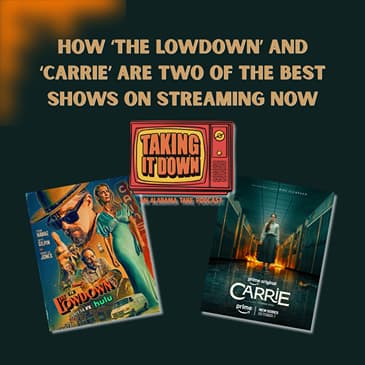





This week, it's the two great streaming shows currently: 'The Lowdown' on FX/Hulu and 'Carrie' on Amazon Prime.
The hosts begin first talking non-spoilers on 'The Lowdown' (1:02) before getting into non-spoiler thoughts on 'Carrie' (9:14).
After a break, they detail the first episode of the second season of 'The Lowdown' (16:18) before getting into what makes 'Carrie' so great through its first four episodes (35:54).
For more, visit the website The Alabama Take.
[00:00:00] Hey everyone, welcome to Taking It Down, the TV podcast for The Working Man from the website The Alabama Take. Today it's Donovan and it's me. We'll be discussing the Amazon Prime series Carrie from Matt Flanagan. And first we'll be discussing the return of the Hulu series The Lowdown. As always with each of our episodes we'll start with non-spoiler ideas before a break that separates those thoughts from the spoilers. So let me welcome Donovan into the podcast and we'll get started.
[00:00:27] I'll be taking projection. Okay, joining me now it's Donovan here for the episode 301. Adam is off this week's making a record in Water Valley, Mississippi at the famed Dialback Sound Studio. He seems like he's experiencing some of the most interesting smells known to man. Maybe some.
[00:00:59] Donovan, a show we've particularly enjoyed last year was a bit of surprise to us in a way. And that's Sterling Harjo's The Lowdown on Hulu. Surprised to me. Surprised at how much I liked it. Surprised at how much I felt it held together as a cohesive whole and told a great story. It was a bit of a surprise. Just not on our radar to begin. But now we definitely know about it. It's in its second season. It's about Ethan Hawke's character, a true historian, as he deems himself.
[00:01:29] He's the sort that'll dig up a mystery or a crime and get into antics in the pursuit of finding out more about it. He's also the sort who gets punched a lot. Yes. He's a very punchable character in this fictional Tulsa. You know what I realized about his character, and I don't remember if I've said this before, but watching the first episode of the second season, and this is nothing but a compliment, he would be a great Coen Brothers character. It plays a lot like a Coen Brothers.
[00:01:59] It does, and that is to its benefit. Right. It does so without being a ripoff of it. Absolutely. It's got its own thing to say, its own vision. I don't want to bore listeners with our travels, but you and I got a chance to see the set of The Lowdown on a trip to Tulsa this summer.
[00:02:18] I think that my wife really does not enjoy watching this show with me anymore, because every time they show anything in downtown Tulsa, I'm like, oh, I was there. Oh, I was right there. I looked at that map. So many places they showed in the first episode was places we were just standing around. At one point, they're sitting on a bench in front of his bookstore window, and there's the stack of papers you can see through the window, and I'm like, I took a picture of that stack of papers. That's right. I did.
[00:02:46] But even just downtown Tulsa, or the, I don't want to get into spoilers, but he has a, the very opening scene has him going to receive an award, and we were there at that point. We were there, yep. Yeah. I'm like, that was fun. I mean, not everyone's going to experience that, but that's been an extra layer of fun for me, feeling like a show that has such a great sense of place, having actually gone to that place and seeing, having seen the place, being like, wow, this show really has a great sense of place.
[00:03:16] Like, it is a show about Tulsa. It's the cliched thing where the city is a character unto itself. You know, you don't often get that outside of like, you know, you kind of think of like, okay, that's New York City, you know, that's Chicago, you know, it's the classic naked city line, right? That's New York City, that's Chicago, that's something else, Boston maybe. Maybe. Don't get that with Tulsa too much, but it works.
[00:03:42] If you've been there and you watch this show, you get a true sense of how rich that place can be. Mm-hmm. Absolutely. So it's really cool. We were there, of course, as recruits to the Golden Hurricanes football team. Yeah. Visiting. Oh, I'm actually, this is interesting. I'm actually the fourth string backup quarterback for Tulsa, but I don't think they need me this season. I'm waiting on that call.
[00:04:08] I think we all are the fourth string backup quarterback for Tulsa. Not to damn a show with some faint praise, but I like this because it's quirky. And I realize that's a word choice that's used a lot as well as the city being a character. But it all fits. But this one's interesting, it's well-directed, it's kind of funny. Very funny, I think. There's a lot of enjoyment to be had here. I watched with a grin on my face. Yeah, I do too.
[00:04:37] You know, there's what, three episodes out now I watched the first one. The whole time I'm just like, and it feels so assured. Sterling Harjo, obviously he's, you know, he's not like a rookie writer, but I feel like he just has, the vision is there. It just feels like such a cohesive haul. The cast this season is stacked, which helps a ton.
[00:05:01] We got Betty Gilpin, Tommy Lee Jones joining, Shane McRae from Silo, and Austin Emilio. I know him from The Walking Dead, but I'm sure he's done more than that. But these are great actors. I mean, it was really fun to see Betty Gilpin, especially coming off of her Emmy win for Widow's Bay. And she's great. She and Ethan Hawke together. She's great.
[00:05:27] She and Ethan Hawke play together very well, especially with her reactions to Lee, who is not an easy person to be around, I think. Right. We like him as a character, but I don't know if we'd like him as a person. Well, and I think they even, you know, jump, kind of start jumping into that with, not to get into spoilers, but with this first episode. I think, you know, this show, you know, he's the protagonist. There's an element.
[00:05:53] I think the show definitely showcases the things where he's lovable. There are things that makes him lovable that makes him admirable. I don't think this show sugarcoats who he is. And I think that is especially well done through his relationship with his daughter. Yeah. It's a well-made show. We said that. One thing I like about the writing is the dialogue feels real. Yeah.
[00:06:22] It balances that realism with some excitement of the plot that is probably much less real, but. I think the dialogue is real. I think this is where, you know, it's funny, Blaine. You probably said the same thing last time we talked about this for season one. I could have. You said quirky. And I think that's what I meant. And often I, like, if you describe something to me as quirky, I'm like, I'm probably going to hate this more than I've hated anything else. But that's what I meant when I said this could be a Coen Brothers character.
[00:06:50] Like, it is that good kind of quirky where it's not weird for weird's sake. It's weird because it's coming, because the character is weird, because people are weird. It's very natural. It's natural. And I think that's exactly it with the writing. One of the things I love about just seeing some of the characters we've seen from the first episode or first season back is, you know, they're here with their own problems. Honestly, part of the funny is, like, they just don't have time for these bullshit.
[00:07:19] And bullshit it is. It's a lived-in show. It's organic in a way. Very good. I can tell you what, after seeing this, this is completely just back to our travels. But having, I've never been and seen a film set like that. And I'm just amazed at the level of craft that is going in to a show like this. And I guess that's probably the same for just about any good TV show.
[00:07:48] But I'd never seen it before. And I was deeply impressed. Like, it feels real. If you go up to, you know, when they're not shooting the set, you would think that you were in a real place. You look through the windows, you couldn't tell it. Any of these shops are not real. Amazing. Right. It's a funny show. But the thing is, there's plenty of drama and excitement with being in Lee's shoes. You find out what Lee finds out as he goes along, the Ethan Hawke character.
[00:08:17] So trying to find answers to questions to what's wrong in Tulsa is an exciting 45 minutes each week. Yeah. Very well paced as a show. Yeah. It is extremely well paced. It doesn't hurt that like even your, not what am I trying to say, like the supporting actors, it doesn't hurt that they're great as well. You know? Like in pretty much every scene. I'm excited.
[00:08:44] You know, we had that great episode with Peter Dinklage last year. I'm kind of excited to see what else we have, what else this show has up its sleeve. Because honestly, just pulling in Betty Gilpin and Tommy Lee Jones right from the beginning is doing a hell of a lot for me. Truly a great, I don't want to say cameo, guest star in episode three that everybody's going to be pleased to see. I won't say more, but yeah. Mm-hmm. It's wonderful.
[00:09:12] Let's slip to another series that has our attention. It's the Mike Flanagan-helmed Carrie on Amazon Prime. We did mention this a little last week. We'll dive into it more this week. Mike Flanagan's the creator of the Netflix show The Haunting of Hill House. Also, The Haunting of Bly Manor and Midnight Mass, all of which we like to varying degrees. Yeah. I'd put Hill House. Midnight Mass. Midnight Mass. Thank you. I'd put those up pretty high, actually.
[00:09:39] Midnight, definitely, you know, Mike, our pal Mike is definitely, there's sometimes flaws in his product, but he truly is able to create an engaging adaptation or an engaging show or both. And, you know, I think we've seen that with his movies, too. He seems to be Stephen King's number one adapter these days with Gerald's Game and Dr. Sleep and things like that. I thought Gerald's Game was actually very good.
[00:10:08] Another thing that I do think makes him impressive, too, is that he kind of seems comfortable no matter what the size of his canvas is. And I'm thinking of movies like Oculus or Gerald's Game where it could almost be a stage play. Like, Oculus mostly takes place in one house, like one not-that-big house. I think he's a versatile guy. And even if I don't think something is great, like I think it would follow the House of Usher, I don't think it was great.
[00:10:36] I had a hell of a lot of fun watching it, though. And there was some good stuff in it. Yeah, he's good. Mm-hmm. And he's the reason why my eye is on this. If you would have told me there's a Carrie remake, I would have said, okay, fine. And if you would have said it's on Amazon Prime, I would have said, oh, okay, talk to you later. Yeah. Exact same reaction, Blaine. Because I think, well, I said this last time we talked about it, but, you know,
[00:11:04] I think the question for any kind of Carrie adaptation at this point is why. Mm-hmm. I mean, the De Palma movie is so iconic, for one thing. We've had a reboot within the last ten years, or a remake. Not even to mention the terrible sequel. There is a Carrie too. Yeah, that's right. That's right. No one knows about. Because it's not good.
[00:11:26] But so, yeah, like Flanagan kind of knowing that, I do think he is good at adapting things, and he's good. I think one of the strengths of his Hill House was that it is not an adaptation of the book, but he does a good job of picking up stuff that was in the book. Mm-hmm.
[00:11:47] And moving it into his show in a way that I think, like, respects the original material without being, you know, it was a real strength dance. Yeah, not to rehash the conversation from last week too much, but this is a show that's working on a few levels. You can watch it with the story, or you could think about it and find it'll reward some deeper watching.
[00:12:14] It's not Dostoevsky, but it's operating with some thematic ideas in mind as it goes along. I think it's pretty good, honestly. I think it's pretty good. This is a side note, but, you know, Mike Flanagan has inked a deal with Prime to make TV shows, you know, much as he had with Netflix. Right. Reading more about Mike Flanagan for this, do you know anything about nerds, Blaine? Only my own nerdom, which is sporadic.
[00:12:44] Are you familiar with Warhammer 40,000? So, yes, but not really. The term is familiar, but other than that. It's real nerd stuff, but Henry Cavill is a huge nerd, right? Oh, I didn't know that. And he, oh, he's a massive nerd. He loves, it's a tabletop miniatures game, and it's spawned into its own universe, and Henry Cavill is one of those people who he actually enjoys, like, painting the little miniatures.
[00:13:09] And he's been working for years with Prime on getting a Warhammer 40,000 series out there. And it seems like this is something that Prime is potentially willing to sink a ton of money into, a la The Rings of Power, and something that I'm truly not really interested in at all. And then reading this week about Mike Flanagan, it turns out he just got tapped by Prime and Henry Cavill to be the guy who adapts this series. Nice.
[00:13:40] That's kind of interesting, him stepping away from a horror. I was going to say, it seems like a different direction for him. And honestly, like, I like Mike Flanagan enough. I might, and, you know, Henry Cavill is creating this series to star in it. I might watch a little bit and see if it's any good. This is years down the line, but I thought that was really interesting. But, you know, if you're sitting around like, who's the guy that's good at adapting things, right?
[00:14:08] Like, there's got to be a somewhat shortish list with Mike Flanagan on it. Yeah, for real. I just, I thought that was very interesting. Definitely outside of his kind of more usual wheelhouse of horror and the gothic. If I'm not mistaken, Carrie's getting some good reviews too. It is. I had my, I haven't had my finger on the pulse of reviews and things like that. Yeah, it has been getting pretty good reviews. And maybe some buzz with people watching it as well. I think so.
[00:14:37] And apparently, you know, all the episodes came out at once. So I guess this is sort of a spoiler. I haven't finished them. I'm five in. But I did see news that there is a season two that has just been announced, which I was surprised by. I kind of assumed it would be a one and done. I also haven't seen to the end. Yeah, same here. Apparently, this is something that Flanagan had in mind from the beginning. He was hoping that this would be a multi-season thing. So it's not like. Okay. Odd. Interesting, right?
[00:15:07] I think that kind of colored my, has colored my, some of the questions I have about it. But yeah, getting pretty good reviews overall. Okay, well, if you know that information and are going forward, I suppose I should have known it too. Honestly, I see so much of this stuff because I'm like, I cannot remember that actor's name. So I'm like looking up the TV. And then the other news pops up, of course, because I was trying to remember all of the actors' names. We'll review that list and take a quick break.
[00:15:36] On the other side, we'll talk about The Lowdown and spoilers, as well as some of these first four to five episodes of Carrie in spoilers.
[00:16:15] Okay, we'll get back to Tulsa and the show The Lowdown. And a note we're going to be discussing and spoiling the first episode of the second season that's airing. Though there are three to watch out right now. It's a show that drops weekly. You might be a little ahead of us. We've got Betty Gilpin on board. It's public defender Ginger. And the great Tommy Lee Jones is in this season as Lee Rabin Sr.
[00:16:44] Which is a storyline I didn't see coming. I'm sure there's nothing thematic in this show about fathers and children. Yeah, well, certainly a chunk of first season dealt with that, of course. Your sarcasm, of course, jokes at that. Yeah, yeah, of course. It was surprising, but it was like once it showed up, it's like, of course.
[00:17:10] You know, there was so much richness in that in the first season. There's a funny episode of It's Always Sunny from this season where they insist on labeling sarcasm. You have to label it. You have to say it. I'm very, I'm not sure, but I think I might have seen a little Easter egg about an Oklahoma writer at the end. So we'll see if I see any more. I think Sterling Harjo has some little winks on some writers here. Okay.
[00:17:40] In episode one? In episode one. Well, let's get into it. Let's start there. What is it you saw? So Ginger's last name is Lafferty. They don't say it, but you can see that her last name is Lafferty on the card. R.A. Lafferty is this really, really weird guy. He was writing 50s, 60s, 70s, I think. Oklahoma writer wrote very strange stories.
[00:18:08] The kind of stories that are like whatever the genre is that he wrote. Kind of you would say science fiction or fantasy, but really not in any expected way. And he's kind of like whatever he was writing, he was kind of the best at the world at doing it. He's sort of uncategorizable. Everything from – and he's not super well-known, but he's been studied by academics as having even feminist themes in there.
[00:18:36] There are themes about indigenous people in Oklahoma. And Lafferty is not that common of a name. So as soon as I saw that, I was like, I wonder if Sterling's giving us an old wink to Lafferty. I wonder what that would turn into, if anything. Could just be how Jim Thompson was kind of in the last season as a – his books were somewhat influential.
[00:19:03] But I can wholeheartedly recommend – he's been out of print for years, but I believe Tor has in print the best of – I think it's the best of R.A. Lafferty. Collection of his short stories. He was a weird dude. Okay. Good eye. Yeah. You may not necessarily love them, but I think if you read them, you're like – if you're the right kind of person, you'll love them.
[00:19:28] And I do think if you read them, you'll be like, there's kind of no one else who ever did what he's doing here. So we'll see. Sterling knows his authors for sure. So I thought that might be a fun little nod. I like that anyway, if that is anything. Yeah, you get the sense that Lee Raybond's knowledge of literature and authorship stems from Sterling Arjo as well. For sure, yeah.
[00:19:58] One critique, maybe the only one I really have of the lowdown, and I might have said this last season too, but I find Lee a little too bumbling to be as intelligent as he's supposed to be. I think you had said that last time. It completely works for me, right? Because intelligence and just kind of being a dumbass are not necessarily mutually exclusive.
[00:20:24] He's a smart guy, but he's the kind of smart guy who's like – he just doesn't think. Oh, well then I find that very relatable. That probably makes me in a situation. You know, he's a smart guy who can't help – he can't stop getting in his own way. That's so true. And it's not so much that. I think that's good, and it's good character development.
[00:20:50] I think it's the literal bumbling, tripping and running into things. And, you know, he does that – Oh, that cracks me up. He does that quite a bit in between any kind of dialogue. I actually love that because so much of it is like it's him trying to be slick. Yeah. And he just kind of like fucks it up. Usually trying to impress a girl or something like that. So that completely works for me. That completely works for me.
[00:21:18] In many ways, Lee Raybon is – he's a teenage boy, right? He's kind of in that state of arrested development. Yes. Which makes sense this season when you meet his father and you find out a little of that backstory. Uh-huh. Uh-huh. So it's well written in that way. But the bottom line for anybody interested is that this show is well directed, well acted, well scripted, and tells an interesting story. It seems each season if it's going to have multiple seasons.
[00:21:47] But this season's already got something cooking that I think is interesting. Interesting. I mean, the question, right, for any show, even one you liked on a second season, right, is like, did I need any more of this? Right? You know, it is kind of like, why does this exist question. And for me, I can pretty much recommend – I mean, this is definitely very high on the last season. But I can pretty much recommend this one without any reservations.
[00:22:17] At no point was I like, why does this exist? It feels like it's extending things that it had brought up in the first season while bringing in new things, new themes, new characters. Great. I'm three episodes deep. I'm seeing all that's been released. And, yeah, I think that this season could easily be better than the first. That's a pretty – you know, that's a pretty – that's pretty good for a sophomore season.
[00:22:47] You do truly often get that slump. You know, they've kind of put every single thing into that first season, everything they've been thinking about and working on. And then the second season rolls around, and it's like, okay, now we got to follow up on that, right? It's difficult is what I'm saying. This first season has Lee winning an award that he's none too happy about, but he does go to accept it. He's got the seriousness to accept it on mushrooms. Yes.
[00:23:16] He had a mushroom gummy. I know his speech angers a lot of people at this journalist award banquet, but I thought it was excellent, if only a little loose. It's a little loose. And I think it's, like, understandable. I thought it was completely relatable that the – because, like, there's a sense in it that's like, well, Lee, you're not wrong. But also, not everyone can be you. Some people want to have, like, a life. You know? It's true.
[00:23:44] Some people want to just report on their community, and that's fine, you know? Some people don't want to show up on mushrooms and give award speeches. Yeah. It's at this award where he meets Betty Gilpin's lawyer, whom we know as Ginger Lafferty. Lafferty. But we don't – I don't think she says that. It's just on her business card. She never does.
[00:24:13] She's going to call her by her last name, and I'm going to have to note that later in an episode. She mentions – I don't know why, too – but that it is her maiden name. But then she says she's not married. So who knows? Yeah. I don't know if that was just a bit of comedy or what. Yeah, I don't know either. But he meets her. He's instantly attracted to her. Turns out she's got some issues. She thinks she's being followed. Turns out she is.
[00:24:39] She's been a lawyer for this guy named Dean Malco. And he is in the criminal justice system. He's at a prison. But she can't get in touch with him. And she's starting to worry a little about him. And that's where Lee Raybon comes in to be the knight in shining armor for her. At least in his own mind, right? For sure. Even some good jokes about that with, like, when she realizes he's in the white van. And he's like, yeah, good guy. White van.
[00:25:09] She's like, that'll be the first time. That's a good joke. It's really great. Gets the old roop-a-doop. Exactly. He goes to the prison. And instead of getting the actual guy, he gets the roop-a-doop. Killer Mike's character has to inform him. That's what it's called. And then everyone else seems to have heard of this term that he's never heard of.
[00:25:30] That's when you have a person who's being substituted in because the real person's in hiding or just doesn't want to come out or for whatever reason. He's like, that's a roop-a-dope. He's like, no, that's something completely different. Yeah. It's great to see Betty Gilpin in anything, but watching her with this distinct nervous energy. Oh, yeah. Especially for a lawyer. Usually you expect your lawyers to be calm and collected in these sorts of shows.
[00:25:56] But I thought it was just exhilarating to see her like a tissue paper in the wind at times. I mean, reasonably smart, self-assured in many ways, but also getting a little out of her depth in others in the sense of she should reasonably be frightened.
[00:26:14] And I thought the – again, just in the first episode, we bit with her at her house after she's fired her pistol and Lee comes back to check on her. And she is – she's all kind of like – she's both like very wound up and just not having any of Ray's bullshit when he's like, go take a shower. Check yourself for gunshot wounds. He's like, they're not ticks. Yeah, for real. That was a good line.
[00:26:42] They were very funny there. And then she's going like, I used to have dreams I'd shoot. So like it's just all coming out at the same time. But not in a way that makes you seem like silly or hysterical. Like very reasonably, you know, she's concerned because she just shot somebody. She's rattled. She's rattled. She is so funny, Betty Gilpin. She is so good. She's very good and playing a different kind of role than maybe you've seen her. Mm-hmm.
[00:27:09] And I think I haven't seen her with this sort of shakenness to her. Same. If she's not enjoying this, she's certainly doing a good job of pretending she is because – For real. It's really good. Just the like – like Lee – this is kind of what you were talking about, like the bumbling. And there were some – there were some things that like Lee is doing to like try and impress her. And he just comes – kind of looks like a dumbass. And that is so perfect for me. Like that dynamic. Yeah.
[00:27:39] And yeah, it does work when he's in that kind of situation, especially when he's trying to impress a woman. He's like flipping his hat and he can't do it right. You talked about her fire and her pistol. The reason why is the two men who are following her, one of them does end up on her porch trying to probably break in or spy on her. And she shoots him.
[00:28:00] The other guy turns out to be one of the guards at the – one of the security guards at the prison when Lee goes to scope out where the hell Dean Malco is. Yep. The guy's showing up at her house. He's got the SS lightning bolts tattooed on his neck, which leads Dean – not Dean – Lee to say he's got a lot of experience spotting skinheads even if they have hair. You're right.
[00:28:31] That made me laugh. But yeah, obviously – and then of course the reason that Lee is there is he has to show up to tell Ginger that he accidentally said her name while being taken in by the Rupa-Dup. So now of course they – the mysterious they know that Ginger is suspicious. Right. And might need to be silenced for whatever reason. Right. And there you go.
[00:28:59] There's your inciting incident for the most part. It's good and it works for me with Lee's character. But like there's still comedy in it too, like as he's trying to tell her. And she's like, you said my name. He's like, well, he said it or I said it. Like he's so full of bullshit. It's great. The stakes do get raised in the second episode. I'll sit on that notion.
[00:29:24] Because I want to shift gears a little and say I was worried they were going to handcuff Tommy Lee Jones with dementia and not let him cook. Yeah. Once he tells Waylon, that'll ruin your life, that dope weed. I knew we were in good territory. It's such a joy to see Tommy Lee Jones in anything. Truly one of my favorite actors. It's the same. I think this is just because he's such a good actor. But it did make me kind of think of totally different characters.
[00:29:51] But, you know, like the Coen's using him in No Country for Old Men and how good he is there. And like in the back of my head, I was like, I wonder if Harjo is a Coen Brothers fan and might – Oh, you got to think. If somebody writes into this show and is like he hates the Coen Brothers, I would be very surprised. Like he can't stand them. Yeah. I'd be shocked too. It seems as though he is doing an homage at times to what they've done.
[00:30:17] Even – I don't know if it's an homage to what they've done or if it's just kind of pulling on that same kind of – I mean it is a little bit of what Bob Dylan famously call it, right? The old weird America. They're kind of tapping that same vein, which I love. Yes. I mean I think that's kind of like you said earlier. It's part of what makes it so great, right? Like who would think Tulsa, Oklahoma could be a character?
[00:30:42] And yet when you start getting beneath the surface of anywhere, that old weird America is still there. I think they even do a wonderful job of framing this in the first episode talking about the good, the bad. They have really explicit stuff from the massacre, the Black Wall Street massacre. And that's what the old weird America is, right?
[00:31:06] When you start scratching beneath the surface, it's old sins and it's old regrets and it's good people doing bad things and bad people doing good things and everywhere in between. Yeah. I don't think three episodes in that the show's yet to reveal all of its themes, though. It's certainly going to be familial.
[00:31:28] Dad coming back into the scene and, of course, Lee reckoning with having his own daughter yet not fully in her life. Yeah. Yeah. And I thought I really thought the bit with Lee's daughter in the first episode where she meets him and is kind of like, why can't you just be normal?
[00:31:49] And he's like, you sound like your mother, you know, like it really, really kind of shows Lee's childishness because it's not also him getting mad at her being a normie because she has a stepdad, Dennis, or Dennis' stepdad. And now it was funny, but like it's really, you know, it's really like he's making her act like the adult and he's playing the child who doesn't want to hear anything real. He just wants to be praised.
[00:32:15] It's really cool that these elements you've mentioned so far all play a role in episodes two and three. The writing. I mean, obviously, it's so much that goes into it. Love the acting, love the directing. But the writing is so solid. I'm just impressed with somebody who is able to kind of like bring these things out in a way that makes them obvious, but not like getting whacked over the head with it. You know, makes it makes it more interesting rather than feeling didactic.
[00:32:43] What makes this show great is that I guarantee you tons of the audience of this show will watch it, appreciate it, love it, enjoy it and rest easy with that. Yeah. Yet you could dig into it. You can dig into it, which we're doing. It hides its eccentricities. It hides its complexities in its simplicities. Mm-hmm. Mm-hmm.
[00:33:11] It takes a lot to do this kind of writing and pull it off without seeing the stitches that hold it together. That's exactly right. Yeah, you're totally right because I think all of us have seen – this is the bad side of Corky, right? Like all of us have seen the movie that tried to be, you know, oh my – I mean, my God, how many – you know, post-pult fiction, how many bad Tarantino knockoffs were there? And you could see the stitches on all of them. Yeah.
[00:33:40] There is some Tarantino here. I do see some of that. I just – this – I think that's what I – kind of what I mean with being impressed by how assured the writing is, how confident it is. Because you – it doesn't – it could be very, very creaky if done poorly. Mm-hmm. And if there's – one of the great things about this show is if it's creaky, it zips right on to the next great thing so you don't even notice it. But I haven't seen any creakiness yet. I did in the first season here and there.
[00:34:08] It wasn't that big of a bother, but here I haven't really. Yeah. I think – I mean, you're in for a treat for these second and third episodes. You're going to get some characters you will have spotted in Reservation Dogs. You're going to get this great guest star from someone in the third – the second episode has a great guest turn from Paul Schneider, who's had small roles in Kate Feer and Lars in The Real Girl.
[00:34:35] But he's perfect in this episode too, and I could have watched him for hours. It was so good. His back and forth with Lee Rayburn is just what you come to the show to watch. I'm excited to talk more about this one. It's a treat. Like you said, it's a treat. I'm watching it with a smile on my face.
[00:34:58] It's a weekly show on Hulu FX production company behind it, but it is on Hulu once a week. We suggested – I mean, if you made it this far, you probably have watched it. So continue and join us back here. We'll probably talk about it some more. I think this one works as a once a week watch too. I think – especially a show like this, I think it can be – if it's all out at once, it can kind of be like eating candy. You just watch it all at the same time because it's fun.
[00:35:27] But I like the week to week. Maybe becomes – I don't want to say forgettable, but you might speed through it because it's so good. And then if you do that with anything, even something that's great, you might tend to forget a little of the small points that make it wonderful. You will, which I like the intention. I like slowing down like that. Yeah. Let's get back into Carrie and its cruel high school setting.
[00:35:56] First episode had me because – Same. It is definite in its sure-handed direction. The entire runtime felt so well-handled and structured that you don't even notice how well-handled and structured it is. Mm-hmm. The pacing was wonderful. The show as a whole so far, I've seen four, you've seen five of these.
[00:36:17] But it's just that first episode for certain felt particularly moody, thanks in part to such an active soundtrack that it never was used as a crutch. There's no wink, wink, nudge, nudge. Yeah. It's just the latest. Though it's curated carefully. Other reviews have mentioned this as well. Yes, and basically for what you said, Blaine, it's always setting the scene, never like the big needle drop. It's always part of the mood.
[00:36:47] Yeah. Needle drops are great, but not doing that. Even some really interesting choices, like a variation on In the Bleak Midwinter as they're going through – Oh, you noticed that too. Yeah, as they're going through the high school. Interesting choices, but choices that make you think, that's interesting, instead of being like, hey, look at me, I'm a cool music choice. Yeah. Yeah, that first episode, the comparison is not real.
[00:37:14] I was going to say the comparison I'm making is a terrible comparison, but it was almost kind of like watching that first episode of Twin Peaks where it's just everything clicks so much. You're like, okay, doesn't matter if the next one's not great. I got to know what's going on. Mm-hmm. Obviously, this is not Twin Peaks. That's a pretty fair comparison in that way. One thoughtful camera utilization employed in episode one, first period, is Flanagan directed this first episode.
[00:37:42] He chooses to center on Carrie in so many of the scenes, almost every scene she's in. And by doing so, he gives it this feeling that anything can happen to her at any moment. Something's coming off screen that's going to get her. It's not quite scary as some of his other TV installments, but there's a sense of tension and dread in these scenes with Carrie.
[00:38:03] This is perfect for something that I had kind of been thinking of, which is I think that the casting of Cat Summer Howell as Carrie plays into this as well because she is somewhat like a physically smaller person. Yes, she is. And I think that that adds to this sense of fear for her. You know, she's being physically smaller. She seems younger, and I think that goes to with her sheltered behavior.
[00:38:32] But she comes in as like a sweet yet young. I think she's supposed to be about 15. And I think the casting was – first, I mean, I think she's a great – I think she's doing a great job as Carrie. I think she's a good actor. But I do think that just that physical fact plays into this where you just feel like anything could happen to this girl. And it's Flanagan, too, playing with our expectations of knowing a little bit about Carrie or a lot about it if you've seen the first episode and haven't read the book.
[00:39:01] Excuse me, seen the first movie. The first episode is not shy about like 200 people get killed or something like that. I think it's a worse bloodbath than in the book. But, you know, we know that Carrie is dangerous, yet she is sweet and vulnerable and frightened and wanting to do her best, not a monster.
[00:39:27] Yeah, he frames the first episode with a flash forward of after everything that's happened. And he's talking to someone. Some director is talking to survivors of what's happened. And then, of course, the story begins with Carrie's dad dying and her and her mom being sort of found out of living a sheltered life, homeschooled. Nobody really knows about them.
[00:39:57] I think there's a sense to this show that we're all at fault. The overzealous conservative parents and the wild liberal kids and everyone in between causes issues that Carrie faces. Meaning to or otherwise. I do think that's a great observation, Blaine. It's hard to be a kid. You know, it's hard to be a person. Yeah.
[00:40:19] I think that, you know, even some of the people who are like Sue, who is sort of maybe feels bad for her and wants to help her out, has done some damaging things. You know, people do things to her without meaning to. People use Carrie as a pawn in their own little games.
[00:40:39] But I think one of the good things that it does, and I think this is especially good with her mother, is like, you know, when she comes in, for example, and she's furious about, like, the active shooter drills that have terrorized Carrie. Like, there's an element where it's like, I don't want to know what her solution would be. But, like, she's not necessarily wrong, you know? It's like, instead of fixing the problem, we just live with these drills in case someone comes in with a gun. Yeah.
[00:41:09] I thought they did such a really good mention this when we were talking in non-spoilers a couple weeks back, but Samantha Sloyan, I think as her mother, like, she's not necessarily likable.
[00:41:24] But she plays her as very human, as a human being with, you know, she's very strong-willed, she's very principled, and, yeah, she also comes across as someone who actually loves her daughter. Yeah. But wants her, you know, or wants her daughter to be a certain way. Yeah. And Carrie's caught between that in so many ways. So, yeah, I think your observation is dead on.
[00:41:54] We got into this in non-spoilers just a little, but a lot of times you will ask why a movie or show needs a reboot. Cape Fear comes rushing to mind. And we don't have answers, other than perhaps the creator wanted the challenge of improving our previous work. Here, though, Carrie, it's almost as if it needed a good redoing with a modern setting because it makes so much sense in consideration of how cell phones exacerbate forms of bullying,
[00:42:21] which this show's about in big chunks. Oh, yeah. It seems so obvious. Yeah. Having seen it, it works so well. You know, you're ready. I find myself in the sympathy with the teachers who are like, if I see your phone one more time, I'm going to ride it over with my car. You know, like, it's obvious. It's like, you know, the same teenage shit we always dealt with.
[00:42:49] It's like on speed now. These kids are constantly distracted by this when they should be learning. They should be paying attention to each other. They should be learning to work together and be kind. And they're definitely not because... Did you question the reality of any of the scenes with the teachers and students? Because I'm here to answer those questions. Oh. You know what I actually questioned? And this is maybe you would know better than I do.
[00:43:18] But I see a lot of helicopter parents even with going into college. I was like, are teens this unsupervised anymore? Do they have this much chance to get into trouble? Yeah, I think so. Okay. Okay. Because I do see a lot of, like, very hovering parents even as they're going into the college realm. I was just kind of curious.
[00:43:40] It's what's become the classic notion from the anxious generation, which they hover, but they put the cell phone in their hands and that's the part that they're not hovering. Yeah, that's a good point. And, you know, the teachers even bring that up, right? Like, oh, if a parent can't get in touch with their kid right away, they're going to, you know, they can't do no cell phones in school because the parents will freak out. Mm-hmm. And we hear that all the time. Really? Yes. Because you are, it is law now, right? They have to put their phones away.
[00:44:09] Or I should say in Alabama, yeah. In Alabama, it came along two years ago for no cell phones in school from start to beginning, even at lunch. Yeah. And I remember the first couple of days, every single class always brought up, well, what if there's an emergency? It's like, do what we did. Yeah, right. We, I'm still, write your senator. Right. I'm still alive. Right.
[00:44:39] I made it out. Of course, it's another conversation perhaps, but maybe not. That's kind of what this show's looking at. Yeah. Yeah, it's certainly a part of it. And I think that, like, parents' fears are definitely a part of this show because, you know, so much of Carrie's mother, you know, she is kind of, not for herself, but she is fearful for Carrie. Mm-hmm.
[00:45:05] And of what Carrie might do, not in the sense that she thinks Carrie is a monster, but in the sense of she installs a camera in her room to make sure that, just in the sense that she might, I mean, I assume this is scary for every parent, right? But it's kind of like an exaggerated version of, like, what is the process called? Like, differentiation, right? As a teenager, you do begin to pull away. You do become your own person. You often define yourself in opposition to how you've been raised, you know, just because you're practicing being your own person.
[00:45:33] And I assume that there's, you know, that's got to be, I don't have children, but I assume that that's got to be fearful to think about. This show is not necessarily full-blown scary, but every character is operating out of fear. Yeah, yeah. I think you put the nail on the head, too, with talking about some of the camera choices and everything. You know, it's not necessarily scary, but there's just a sense of dread.
[00:45:59] And part of that dread, honestly, for me, is just, like, the same dread you'd see about any nice kid out in the world, knowing they're going to get chewed up. Knowing that their heart's going to get broken. Yeah. Did you rejoice at the sight of Tim Bagley from somebody somewhere in this show? Yeah, I did. I really did. I did. He's completely typecast as a kind gay man. He's the school counselor here, and he just brings a genuine warmth to his role.
[00:46:25] I thought he was great, the bit where he's, how can you not love him? He's truly kind to Carrie. He's also not, he's not willing to put up with Chris's bullshit. Yeah. You know, and, you know, we even see another side of him when he's out getting drinks with the other teachers. I loved it. It was, that was truly, I'm so glad to see, it was like seeing a friend. Yeah, it was. That's how it felt. He's clearly good at his job.
[00:46:55] He's got just, this is, I'm just completely going off a tangent, but something about his delivery in somebody somewhere in here, the way he talks. And he was a teacher in somebody somewhere too. That's right, he was a teacher. You just feel like this is a guy who gets kids. Yeah. This is a guy who gets kids that don't necessarily feel heard or understood by other people. He's a little bit like a gay Ted Lasso. He really kind of is.
[00:47:24] You know, he does something that almost nobody else does. He does something that doesn't matter. He shares a quote with him and he says, I didn't know that, but that is wonderful. Instead of like, hey, Carrie, you didn't know something? Because so much of her experience, right, is not knowing things. He acknowledges and treasures something that she does know and that she is able to share.
[00:47:49] You know, she's, he's, I think, I think that's great because so much of it is like, you know, Carrie's almost operating at a deficit for most of this show. She does, the other people don't recognize what she has to share maybe. The second episode impressed me with how each character got fleshed out without feeling like that's what was being done. Yeah, when this is done poorly, it can feel like, oh, it's this character's episode. Yeah, exactly.
[00:48:19] A lot of times with those shows, they focus on the side character. It's obvious they want everyone to have a story for the sake of the overall piece, which is great. But here, it was so subtle. Yeah. Yeah, I thought it was well done. The third episode's called Social Studies. It's the party episode, as I think everybody's going to call it. Yeah. I thought he did a nice job of avoiding being filler by shading in the hardships that each of these characters face,
[00:48:46] especially the poor mom who's degraded to cleaning some of the worst toilets I've seen on TV. Yeah. That's all, yes. I thought in that episode, I don't think it was filler. I think it was very important for Carrie emotionally in many ways. And other characters getting introduced. We start to see some motivations for actions to come. Mm-hmm. The show's developed characters whom you want to spend time with.
[00:49:15] Even the ones you despise, you still want to say, what despicable thing can she come up with next? I know Chris is maybe not completely sympathetic, but I do think that the show kind of, not plays its hand, but in the first episode, I think it does have something important that it wants us to remember, which is when Sue is being interviewed and she says, the thing that nobody gets is like, we were kids.
[00:49:43] And I think that that has to be part of Chris's tragedy too, because even kids can, you know, kids can, especially big kids, can lash out and hurt and be very, very destructive while still being children and doing these things as children and needing something that they're not getting and harming because they need something they're not getting.
[00:50:10] Carrie is a protagonist that's kind and wonderful and you really want to root for her and you do. And then they get this nice scene at the end of episode three where she and Kristen are both getting rides home and they mirror each other. But these are two girls from very different worlds. Yeah. But both have pains and just deal with them differently. It's a show about struggles of young adulthood.
[00:50:34] Carrie's approach is sort of to internalize, to try to be pleasant, agreeable. Well, I think you could even, I'm not smart enough to do this, but I think there's even something here about like the way women are socialized often. I think so too. You know, where it's like pleasant, conciliatory, uncomplaining, takes things internally. And then, you know, Chris is almost completely the opposite.
[00:51:02] You know, she's lashing out at the world. And I do think that there's another kind of, again, I wish I was smarter about this, but almost commentary about the way women are portrayed. I do think that they're, one of the things that I think I have noticed with this show is that a lot of the directors and writers seem to be women, which I think is an excellent choice because, you know, it is centered around. The boys are on the periphery.
[00:51:29] You know, it really is Carrie's mom, Sue, Chris, you know, the kind of small, Tina, kind of the smaller like girls group with Carrie, you know, as the protagonist. Or not girls group, but their relationships is what I mean. Yeah. A lot of the issues from social media tend to affect girls the most. Agreed. I was, I think you didn't say that wrong. I think you're incredibly right.
[00:51:56] You know, issues around like even like having a body that does things naturally. Having a body that doesn't conform to somebody's idea of what you should look like. Looking or dressing or acting in a way that doesn't fit the role.
[00:52:14] And then, yeah, I mean, you know, it is a little like over the top, but honestly, we've seen like literally in real life, like finsta things like blow up to the point that they've like made it to the national news. So it's like, it's, it's like, yes, it's over the top. Yes, it's kind of, but like, so are teenagers, you know, like they, they don't have, like teenagers do not have a sense of like proportion or moderation. No. Yeah, they are all or nothing by and large.
[00:52:43] What is it with this being the year of TV characters doing the grossest things to drinks or to cups? Thinking Netflix's beef had a bloody scene and then this, this one has a cup in a toilet. I'll admit that I looked away after a minute. Because they just, they just fault, they just focus on, oh, so gross. Oh, I totally shut my eyes. I was, I covered my eyes. Didn't want to see that.
[00:53:08] But the only critique I really have is I do find it odd to the point of maybe unnecessary. The lurker girl, Emmeline, Emmeline. Yeah. I think it's Emmeline. Emmeline. And how she's obviously not who she says she is. It's almost distracting to Carrie's story of friendship, innocence, bullying, and a young girl.
[00:53:34] So you, that's so interesting that you say that because that was my only feeling at the end of the first episode when, you know, Sue or somebody was like, there were other people there. So I was actually, I was talking with one of my student workers who has been watching the show and she was like, oh, kind of reminded me of The Shining. Like they're able to pick up that Carrie has. I guess the thing with her is, right, nobody else can see her, right? Yeah.
[00:54:04] It seems like only Carrie can see her. But I had the concern of like, okay, does this element being introduced, does it add to the story, to the core of the themes, or does it take away? And I'm still on the fence about it. But so that's kind of my exact feeling, Blaine. Yeah, I didn't know if you had any more clarity than I having watched one more episode. No, not really. Okay. In fact, I'm really curious to what happens next because there's sort of a turn in the fifth episode that I wasn't expecting.
[00:54:34] Well, episode four that I ended on was her crying to her mom and really turning toward her. Yeah. Maybe for the first time in the series. Yep. Yep. It was good. After being in the mud where her dad had died, too. Chris really is the worst person on planet Earth, isn't she? Oh, my goodness. You just want to put her in her place. I know. Good chance we circle back around to some of these shows we've discussed.
[00:55:03] I think, you know, we're going to have to talk more lowdown. And I'm curious to hear once we finish Carrie our thoughts on that. For real. I mean, the lowdown is – It's amazing that it went from a show where I saw a trailer for the first season. I'm like, well, it could be good. But, you know, it looks like it's trying a little hard to, like, this is the best show airing on TV right at this moment. You know? I think it's the best one.
[00:55:30] Pretty much the best show currently airing on TV now that Widow's Bay is off the air. Well, these two shows are both really self-assured. Mm-hmm. I think we definitely want to see where we are with them next week, at least briefly. That is it for us this episode. Remember, if someone's filming you with a cell phone, knock it out of their hands. Knock it out of their hands. Pick it up. Run it over with your car. Have a great week, everyone. Bye, everyone.